A private ledger · English & नेपाली · BS & AD
Money goes in a moment.
The record stays.
Write down what you spend and what comes in. Dheba does the arithmetic — monthly balances, category breakdowns, budgets, loans between friends, and trips split with them.
No account needed to begin. Add Google later and everything you entered moves with you.
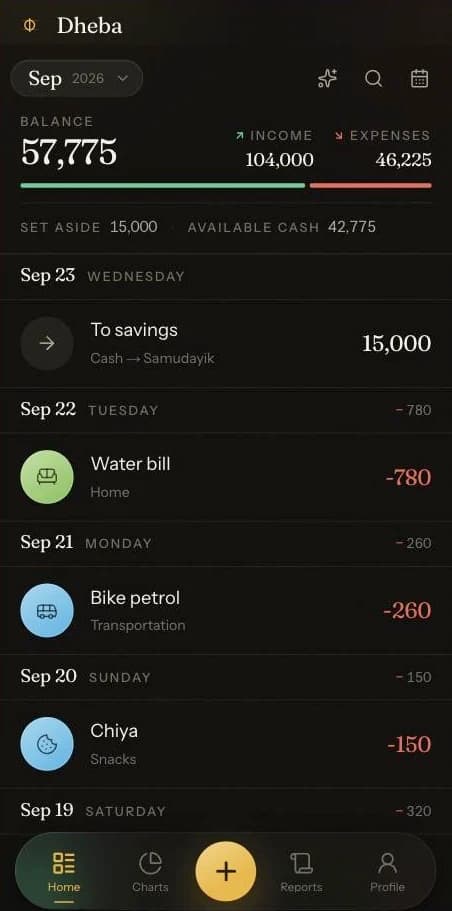
The signal is worst where the money goes.
An expense is written where it is spent — a shop with thick walls, a bus out of the valley, an hour past the last tower. Dheba records it there and sends it when the connection comes back. The entry appears in the ledger straight away, drawn exactly like a saved one, because from where you are standing it is simply written down.
Months you have already opened can be read the same way, and so can the screen you write on. Nothing narrates the wait.
How it goes
01
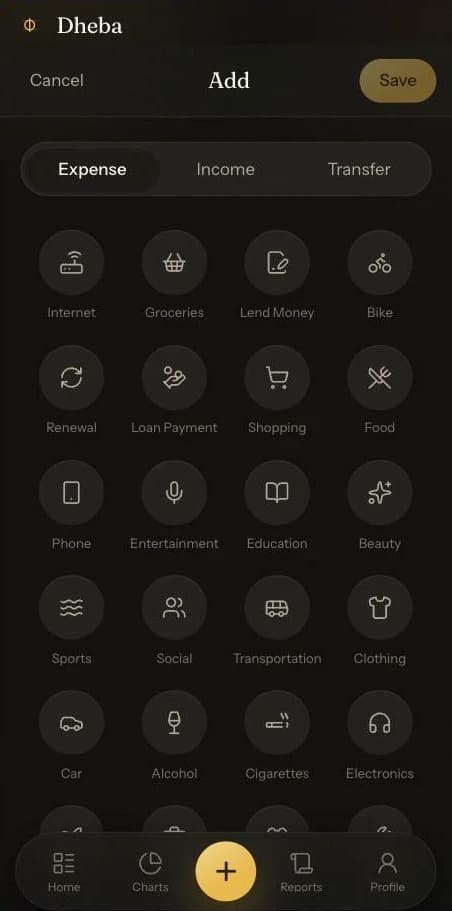
Tap the category, type the amount
The number pad is the app's own, so a receipt can be totalled where you are standing — 240 + 180 + 95, without leaving the screen. Notes you have already written under that category are offered back, to be tapped rather than typed again.
02
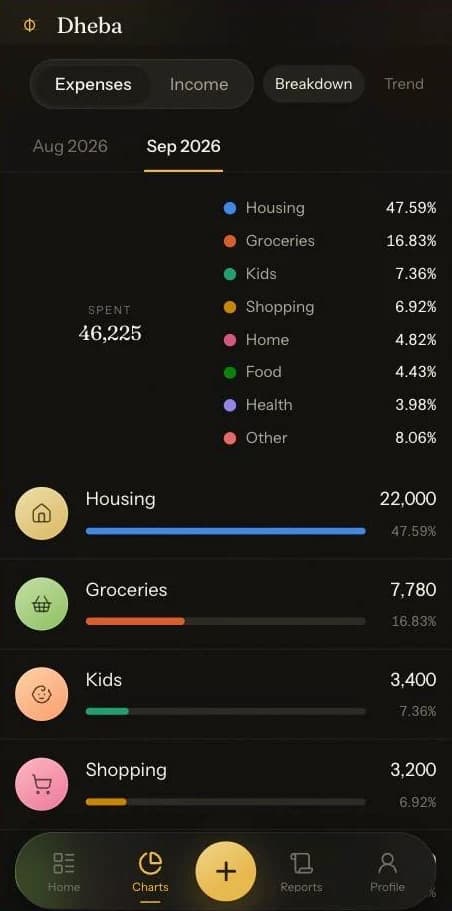
The arithmetic is already done
Every month carries its own balance, what came in, what went out, and how much left reach into savings. Categories rank themselves, largest first. Set a budget and it tells you where you stand against it.
03
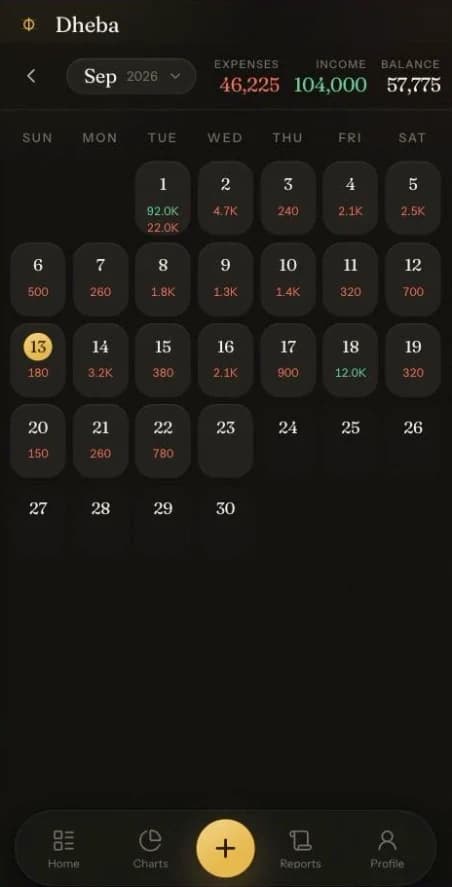
A month you can read at a glance
Each day carries its own total, so a heavy week is visible before a single figure is read. Dates work in Bikram Sambat or Gregorian — the whole app follows whichever calendar you keep.
04
Split the trip, settle once
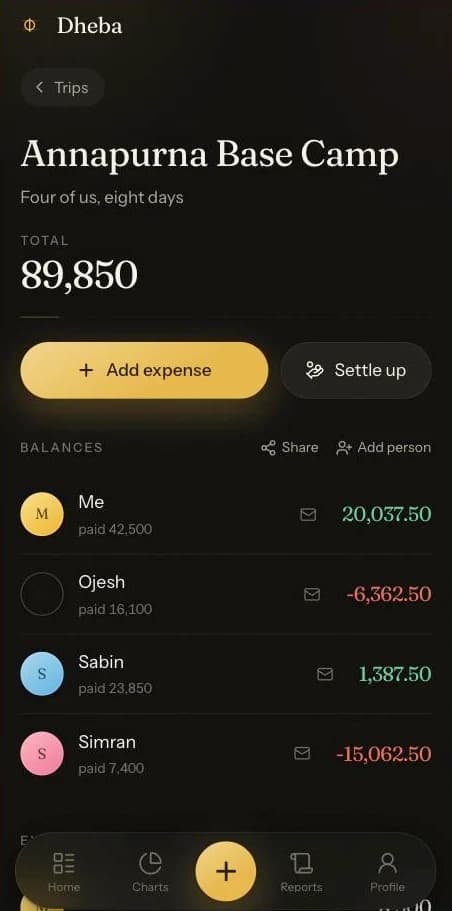
Add everyone who came, log what each of you paid, and the arithmetic stops being an argument. Dheba works out where everyone stands and reduces it to the fewest transfers that clear it — so four people and a week of teahouses end in two payments, not twelve.
For a business
Thirty days freethen NPR 100 a monthWhen the money stops being yours alone
Five people putting money into one firm is not a bigger version of one person tracking lunch. A business has to answer what it owns, what it owes, and what each partner has put in and drawn out — in the form an accountant, a bank or the tax office will accept. That is double-entry, and Dheba keeps it the way Tally does: groups, vouchers, bill-wise references and a day book.
- Four documents, one journal
- The trial balance, the balance sheet, the profit and loss and every account’s ledger are not four things to keep in step. They are the same entries read four ways, so they cannot disagree with each other.
- Every figure opens
- Touch any number on any statement and you land in the account behind it, then in the entry somebody typed, with the other side of it named. No figure on a Dheba statement is one you have to take on trust.
- Nothing is ever deleted
- A wrong entry is reversed, never removed, and both halves stay in the day book under the date they happened. Among five equal partners the audit trail is the point, not a nicety.
Thirty days free, then NPR 100 a month for the book. The owner pays, and every partner they invite is covered by it.
Stop paying and the books stay readable and the export keeps working. They are your records, not ours to hold.
Open a set of booksAnd then you can actually read them
Four tabs, and they cannot disagree with one another, because they are not four records — they are the one journal read four ways. Press any figure and it opens the account it came from, then the entry somebody typed.
What it will not do
- Sell what you write
- There is no advertising in this app, no analytics, and no third party watching you use it.
- Insist on an account
- Open it and start writing. Signing in with Google is a choice you can make later, or never.
- Be vague about what leaves
- Three features send something outward — the optional assistant, dictation, and notifications. The privacy policy names each one and says exactly what it carries.Read the privacy policy
- Hold your history hostage
- Export writes the whole ledger to XLSX or CSV in the same columns Money Manager uses, so a file taken out of here goes straight back into it — or into something else entirely.